
Humans at the Center

Humans at the Center

Why guidance keeps students going

Research shows that human engagement is key to a student wanting to learn, whether the guide is a tutor, a teacher, or a parent.

A Human Keeps Focus

Without a human to guide them, students drift and lose focus. A real person keeps attention on the work and encouragement flowing when it gets hard.

Research consistently finds that students engage more and persist longer when a human is in the loop than when they learn from software alone.

A Human Keeps Focus
Humans in Every Part

Humans in Every Part

Humans are at the center of every part of our learning, from the tutor in a session to the teacher in a classroom to the parent at home.

Our platform supports that human guidance rather than replacing it, because a guiding person is what makes a student want to keep going.

How Human Tutoring Interactions Shape Engagement in Online Learning

Conrad Borchers et al. (2026)
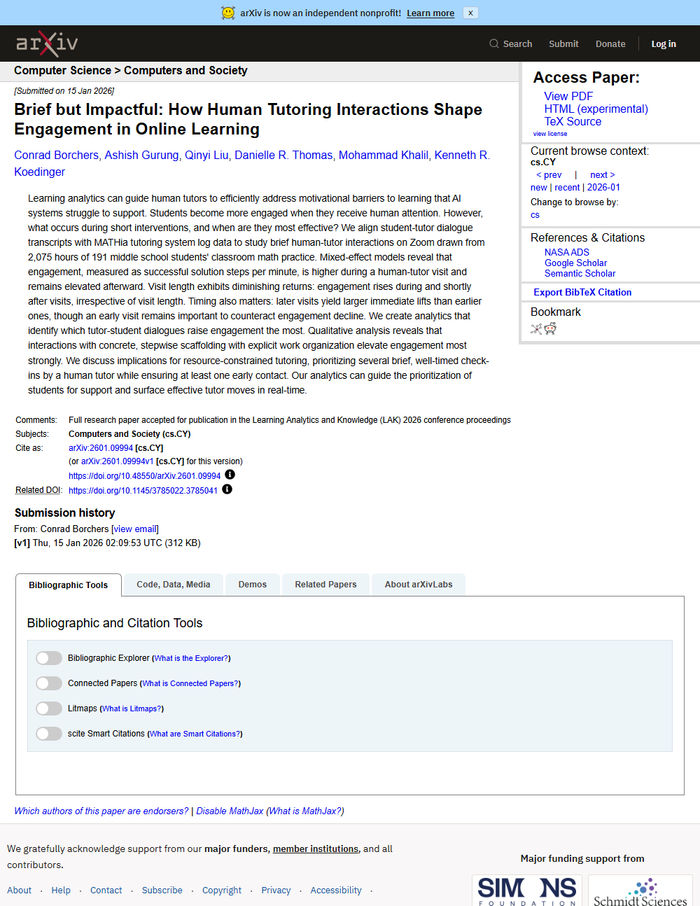
Kids stay engaged and do more meaningful math practice when they work with a real tutor or teacher.
First page of How Human Tutoring Interactions Shape Engagement in Online Learning

This study looked closely at what happens when a human tutor steps into an online math session. Students completed more successful problem steps per minute during and just after talking with a human tutor than when working with software alone. The human presence pulled students back on task and kept them persisting — evidence that a real person in the loop measurably increases how much productive math a child does.

Read the research (2026)

The Impressive Effects of Tutoring on PreK-12 Learning

Nickow, Oreopoulos & Quan (2020)
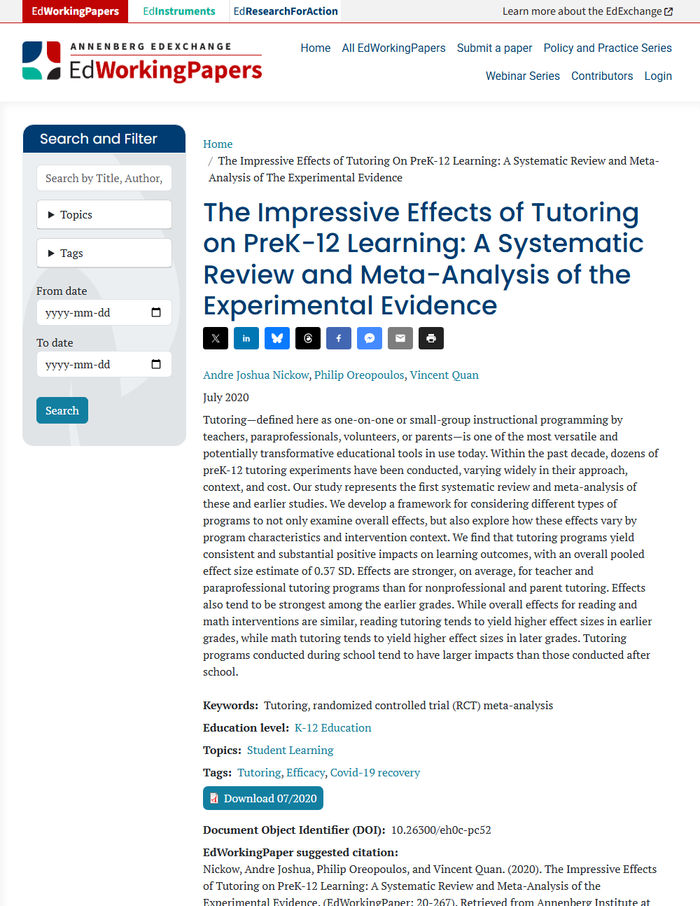
Research shows kids who work regularly with tutors tend to do better in math than those studying alone.
First page of The Impressive Effects of Tutoring on PreK-12 Learning

This large meta-analysis reviewed nearly 100 tutoring studies and found consistently strong, positive effects on learning — among the largest and most reliable in all of education research, with especially clear results in math. Tutoring works in large part because a dedicated human keeps students engaged and productive. For parents, it is powerful evidence that regular time with a tutor reliably moves the needle.

Read the research (2020)

Frequently Asked Questions

Start by grade for quick alignment, by topic for targeted reinforcement, or with skill leveling when placement is unclear. Choose the route that reduces confusion fastest.

It provides a practical readiness estimate to guide placement decisions. It is a low-pressure planning tool, not a high-stakes judgment of student potential.

Yes. Topic pathways can review prerequisites or extend challenge beyond current grade, which helps students progress based on readiness instead of fixed labels.

Use worksheets in short, consistent cycles with immediate review and reflection. Pairing worksheets with interactive practice helps reinforce understanding and reduce repeated error patterns.

Some practice experiences can start immediately, while account setup unlocks progress tracking, personalized pathways, and clearer long-term continuity across sessions.

Progress views show completion consistency, concept trends, and likely challenge areas. Families can use those patterns to choose practical next steps with less guesswork.

Practice can be a strong foundation. Tutoring becomes useful when bottlenecks persist, confidence drops, or goals require faster progress and guided accountability.

Consistent short sessions usually outperform occasional long sessions. Sustainable weekly routines improve retention, confidence, and follow-through better than irregular intensity.

Yes. Advanced learners can use topic pathways and higher-challenge sets to deepen reasoning and avoid plateauing while staying connected to long-term growth.

Parents can support consistency, review trends, and help maintain calm routines. They do not need to reteach math content for progress to improve.