Build Math Judgment for AI
Deep reasoning still matters
As AI produces many answers, Matarus helps tutors guide ambitious students toward the mathematical reasoning and judgment to evaluate, explain, and apply them through regular weekly practice.
Real Challenge, Real Growth
AI can produce many answers, but ambitious STEM students still need deep math and critical thinking to judge whether an answer makes sense. Challenging mathematics helps students test assumptions, explain methods, spot errors, and revise their thinking.
A one-pace assignment can hide whether a student needs a stronger foundation or is ready for a deeper challenge. Matarus shows tutors the skills behind a student's reasoning, so they can use the platform to verify precursor skills before moving into harder work. With that foundation secure, the tutor can choose a richer problem, adjust the support, and see whether the student is ready for more complexity.
Tutors Make Stretch Count
Tutors learn what each student needs, where understanding breaks down, and which explanation is most likely to help. That knowledge lets them introduce demanding work in a way that feels credible rather than arbitrary.
During a session, the tutor listens to the student's reasoning, asks focused follow-up questions, and adjusts the explanation. Students receive encouragement tied to what they are doing well and a clear next step when they are stuck.
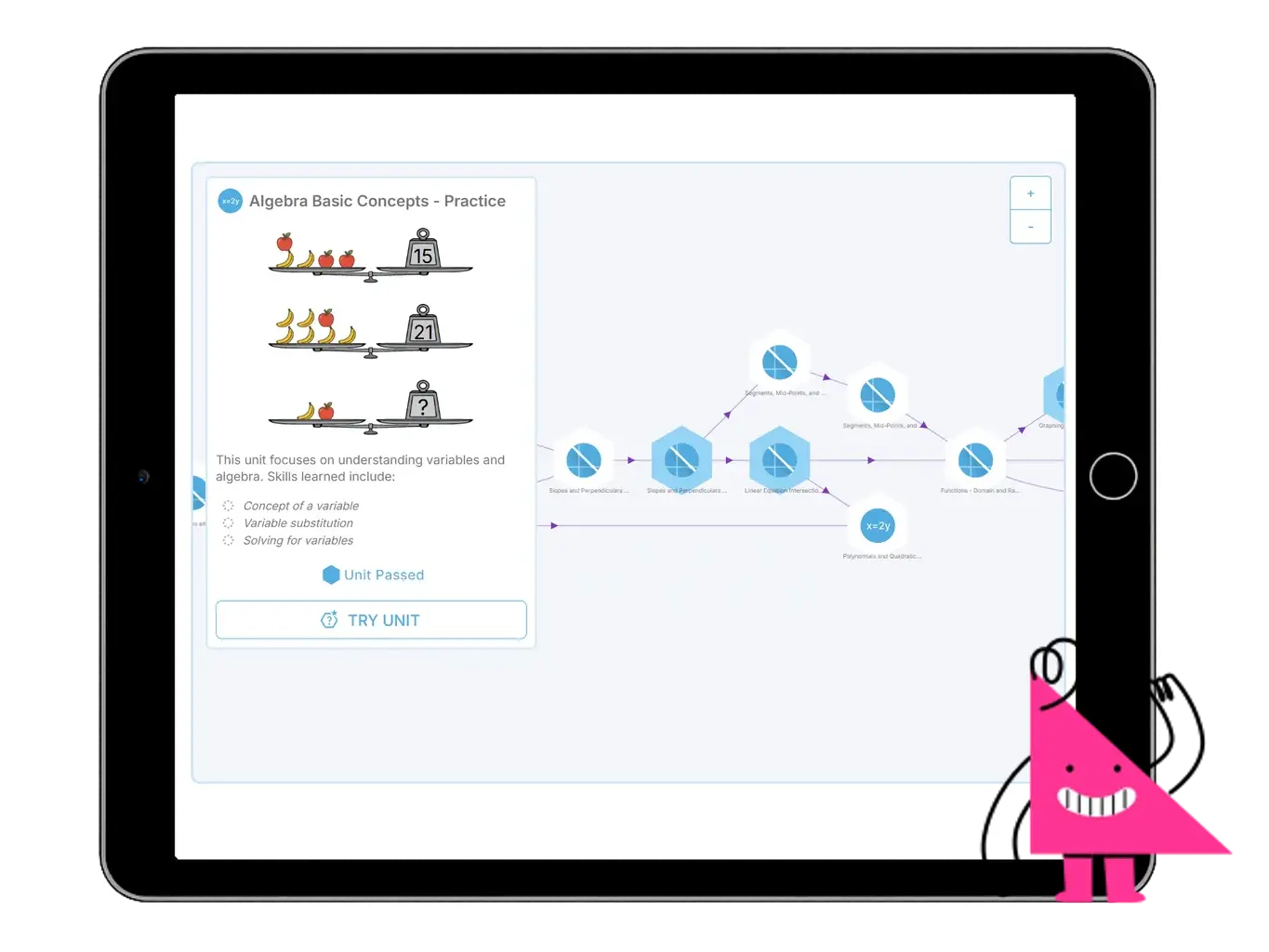

Explanations That Fit
The real gain comes after an explanation. Students can explain the idea back in their own words, apply it in a new context, and compare their result with the original reasoning.
That evidence gives tutors and families a clearer view of growing independence. Instead of measuring progress only by completed problems, they can notice whether the student transfers an idea, revises an approach, and communicates a sound mathematical decision.
How the Method Works
The same method principles support stronger challenge, better retention, and steadier confidence across the full learning journey.
Math Excellence
On-Level
Each kid does math at their exact level.
Spaced Repetition
Concepts are revisited over time to ensure retention.
Active Problem Solving
Majority of time spent solving problems not passively listening
Scaffolded Skills
Kids build understanding through small increments in difficulty.
Adaptive Difficulty
Difficulty adapts with success to keep kids challenged.
A Stronger Start for STEM
Strong mathematical reasoning and critical thinking can support success in demanding STEM courses and help students prepare for competitive university applications. That preparation is not a promise of admission, but depth matters when later work requires students to explain, connect, and apply ideas rather than rely on speed alone. Read about math and critical thinking.
Matarus helps families build that foundation over time. Students can strengthen the habits behind advanced coursework while keeping more future STEM and university options open.

STEM PATHWAYS
Built for students with big goals
Strong math development can support a longer pathway toward future STEM possibilities for ambitious students.

GRADE 1-3
Start strong
Early curiosity grows when strong math foundations make bigger questions feel reachable.

GRADE 4-6
Build confidence
Structure, persistence, and problem solving start to build an identity as a budding mathematician.

GRADE 7-9
Accelerate
As success increases, future plans in medicine, engineering, and technology become more ambitious.

GRADE 10-12
Aim higher
Ambitious students look toward competitive STEM programs at top-tier colleges and universities.

A Concrete View of Progress
For a family, progress may first appear in a small moment: a student pauses before accepting an answer, explains why a method fits, or notices an error without being told where to look.
Over time, those moments can change how the student approaches difficult work. Matarus gives tutors and families a shared way to value careful reasoning, revision, and growing independence—not just faster completion.
Loved by parents and students alike
How Growth Builds
Long-term growth follows a learning pathway: early number sense, middle-school multi-step thinking, and high-school depth build readiness over time. Families and tutors can use each stage to decide when to reinforce a foundation, add complexity, or introduce a new kind of question.
The pathway below shows how Matarus can support steady progress without assuming every student grows on the same schedule. It connects day-to-day work with the skills students need for advanced math, physics, and computer science.
See Growth, Build Readiness
Early grades build number sense, clear explanations, and confidence with unfamiliar questions. Middle school strengthens multi-step thinking and algebraic reasoning. High school develops the depth and stamina needed for advanced math, physics, and computer science. By university transition, this preparation can support course placement and competitive applications without guaranteeing results. Families can track accuracy, focus, explanations, and willingness to revise after errors.

Grades 1-3
Build a passion for math and enjoy the challenge.
Grades 4-6
Build confidence and establish identity as a math person.
Grades 7-9
Develop the key skills that high-school math depends on.
High School
Ace the hardest high school math programs.
STEM Futures
College and university STEM programs
Competitions
Build creative problem-solving skills and confidence to tackle hard problems.
SAT / ACT
Master the skills needed to ace the entrance tests.
- Grades 1-3Build a passion for math and enjoy the challenge.
- Grades 4-6Build confidence and establish identity as a math person.
- CompetitionsBuild creative problem-solving skills and confidence to tackle hard problems.
- Grades 7-9Develop the key skills that high-school math depends on.
- High SchoolAce the hardest high school math programs.
- SAT / ACTMaster the skills needed to ace the entrance tests.
- STEM FuturesCollege and university STEM programs
Make Challenge Meaningful
Ambitious students need more than advanced labels or extra worksheets. A rich problem might place a familiar idea in a new context, allow several solution paths, or ask the student to defend a mathematical decision.
Matarus helps tutors shape that kind of work around the ideas being developed. The result is a meaningful stretch that asks students to connect concepts and communicate their thinking, not simply complete more exercises.


Knowing When to Stretch
A secure foundation gives the student a better starting point for harder work. Tutors can look for signs such as choosing a strategy independently, explaining why it fits, and checking whether the result makes sense.
When those habits are emerging, Matarus can support a gradual increase in complexity. The tutor guides the student through the new demand, keeps the reasoning visible, and helps the student stay responsible for the mathematical decision.
Productive Struggle Builds Confidence
Productive struggle becomes useful when a tutor responds before uncertainty turns into shutdown. The tutor might ask the student to test one assumption, compare two approaches, and identify what changed when the first approach failed.
After that short intervention, the student returns to the problem and carries the reasoning forward. This sequence keeps the student responsible for the mathematical decision while giving frustration a clear next step.

Readier for Advanced Math
Sustained readiness appears when a student can carry strong reasoning into unfamiliar settings. They may connect ideas from different topics, defend a solution, reconsider it when new evidence appears, and explain the trade-offs between possible methods.
Over time, these habits show whether advanced work is becoming dependable rather than occasional. Students learn to transfer what they know, stay engaged through complexity, and refine a solution without waiting for someone else to supply the next move.